
The Insignia of the Order
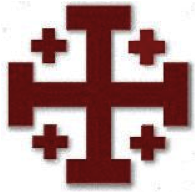
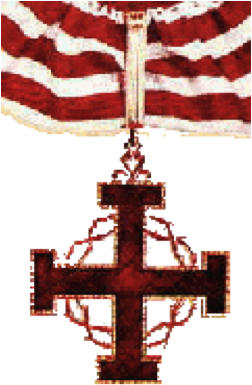
The insignia of the Order is, according to ancient custom, the Cross, which takes its name from Godfrey of Bouillon, and specifically the gold Cross Potent, enameled in the color of blood, with four red crosslets with gold borders attached at the four sides. The ribbon from which the Cross hangs is black watered silk.
Coat of Arms of the Order

The Order carries through ancient tradition the Coat of Arms attributed to the Latin Kingdom of Jerusalem, which is of silver to the Jerusalem Cross of gold and enameled in the color of blood.
A gold helmet, topped by the Crown of Thorns of Our Lord Jesus Christ, at the crest of the terrestrial globe surmounted by the Cross, flanked by two bands of silver with the Jerusalem Cross of cardinal red at the center.
Attendants: Two angels with red dalmatics, the one at right bearing the Crusader flag, the other at left supporting the Pilgrim’s Staff and the Shell.
Motto: Deus lo vult, in capital Roman characters on a forked band under the point of the shield.
Uniform Attire
The Cape or Mantle
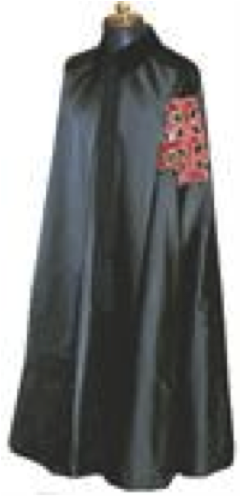
The vesting of each new Knight or Lady with a cape or mantle, a type of choir or church robe given to the Order by Pope St. Pius X, signifies both the robes worn by those redeemed in the Blood of the Lamb at the time of the Apocalypse, and the cloak of justice which is testimony to the union by grace of the members of the Order with Christ, the Immaculate Lamb of God.
As the prophet Isaiah proclaimed:
It is the visible insignia of the Order, marking it in a special, historic way. The cloak or mantle of the Order, revived by Pius X, is the oldest link to the Crusaders, who originally adopted a white woolen mantle marked by a large red Jerusalem Cross on the left breast.
The mantle bears a prominent representation of the Jerusalem Cross, the five crosses potent, which constitute the arms of Godfrey de Bouillon and now are on the banner and emblem of the Order. Their blood-red color reminds us of the love of Christ our Redeemer, of His blood shed for us, His death, and His resurrection.
Beret, Knight

Knight
Scarlet Cross of Godfrey of Bouillon on a silver shield.

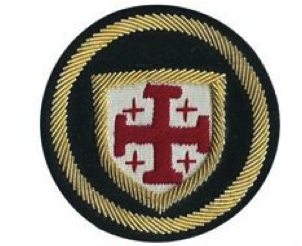
Commander
Scarlet Cross of Godfrey of Bouillon on a silver shield set on a disc of black velvet trimmed by a cord of gold embroidery.
Commander with Star
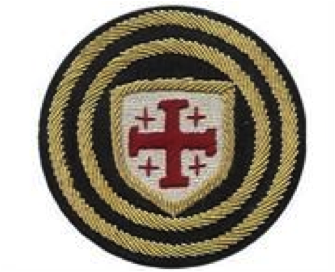
Scarlet Cross of Godfrey of Bouillon on a silver shield set on a disc of black velvet surrounded by two circular cords embroidered in gold.
Knight Grand Cross
Scarlet Cross of Godfrey of Bouillon on a silver shield set on a disc of black velvet surrounded by two circular cords embroidered in gold. The shield is surrounded by a wreath of olive leaves embroidered in gold.

Knight of the Collar
Scarlet Cross of Godfrey of Bouillon on a silver shield, set on a disc of black velvet surrounded by one circular cord embroidered in gold. The shield is surrounded by a garland-shaped Crown of Thorns.
Cape or Mantle, Lady
A black silken cape, with the red Jerusalem Cross emblazoned in the same fashion as on the Knight’s cape, was adopted for the newly accepted women with the title Lady. The black Dames’ cape is an important link to the Order’s history. In the late 1800s, when Pope Leo XIII invited Dames to join the Order, the approved attire for women attending the Papal Court at the Vatican was a black dress, black mantle and mantilla. Thus, this fashion became the standard attire for Dames of the Order.
Mantilla, Lady
Black lace in the Vatican or Spanish mode.

Use of the Uniform
Insignia
Knights Insignia
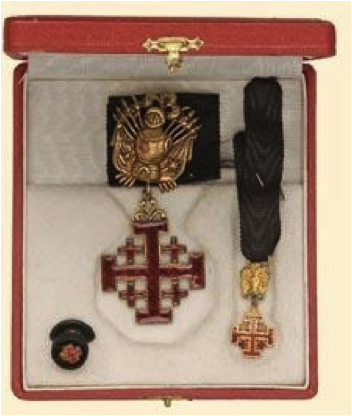
Knights receive three different insignia bearing the Jerusalem Cross.
Ties, cufflinks and shirt studs bearing the Jerusalem Cross may be worn in connection with the ceremonies of the Order or whenever the Knights are representing the Order.
Lapel Pin
The Lapel Pin, a small lapel pin called a rosette, is included in the Knight’s insignia. Its size and design indicates the Knight’s rank. You may wear, and are encouraged to wear, the rosette on any business suit. This is an important witness of the member’s commitment to the Order.
Miniature Insignia
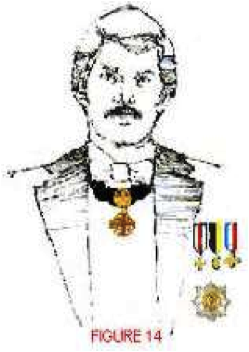
The miniature insignia consists of a small cross or star of rank suspended from a narrow black silk ribbon, which itself is suspended from a small gold pin enameled with stripes of gold and white, the colors of the Holy See. It has the appearance of a traditional miniature military medal and is worn in place of the neck insignia.
The miniature insignia may be worn on the left side of black tie attire, tuxedo, and the equivalent attire for ladies.
Neck Insignia
The neck insignia with the Order’s cross and, for higher ranks, with star, is the principal insignia of the Order and is worn with white tie and tails, specifically at the Investiture Ceremony and formal dinner.
Knight and Knight Commander
The principal insignia for these ranks is the neck insignia with a Jerusalem Cross suspended from a military trophy on a narrow black watered silk ribbon. The Knight Commander Cross is larger than that of the Knights.
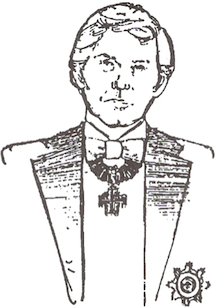
It is to be worn with formal attire, white tie. The neck insignia is worn underneath the white tie and tied tightly around the neck. The military trophy should not hang loosely around the neck but should hang directly beneath the tie.


Knight Commander with Star (KC*HS)
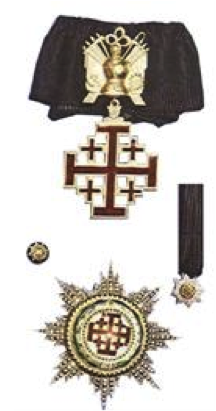
In addition to the neck insignia, Knight Commanders with Star are entitled to wear, with formal attire, a large, eight-pointed silver star, charged with a small cross surrounded by a gold circle bearing a green laurel wreath.
Knight Commanders with Star wear both the neck insignia and the star with formal attire, white tie and tails, and other decorations of the Order.
Knight Grand Cross (KGCHS)
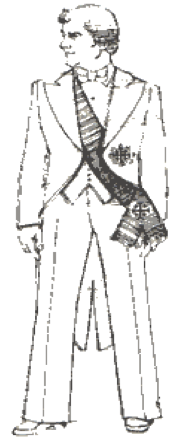
This is the highest rank for Knights below Knight of the Collar, who are appointed by the Grand Master in Rome. Knights Grand Cross wear a large Jerusalem Cross and military trophy suspended from a wide black sash, or baldrick, with formal attire. A large eight-pointed silver star charged with a large Jerusalem Cross is worn on the left breast.
The sash is worn diagonally over the right shoulder with the Jerusalem Cross on the left hip. The sash and star are only worn with formal attire, white tie and tails. The sash is worn under the waistcoat except in the presence of a head of state, in which case it is worn over the waistcoat.
The star is pinned to the lower portion of the left side of the tail coat. It is never worn around the Knight’s neck or pinned to the outside of the cape.
Dames Insignia
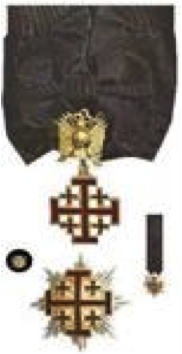
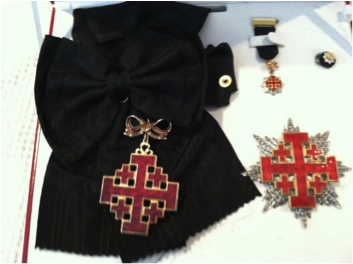
The principal insignia of the Dames of the Order is the Jerusalem Cross worn suspended from a black silk ribbon and worn around the neck. Dames insignia are distinct from the Knights insignia in that the Jerusalem Cross is pendent from a bow rather than the military trophy.
For social daytime or evening attire, Dames of the Order may detach the Jerusalem Cross from its ribbon and wear it hung from a gold chain. Wearing the Jerusalem Cross is a witness of the Lady’s commitment to the Order.

Dames may also wear the emblem stickpin at any time, but not with any other insignia of the Order.
The Jerusalem Cross should be worn as described above. The cross of a Lady Commander is larger than that of Dames.


Lady Commander with Star (LC*HS)
Similar to Knights Commander with Star, Lady Commanders are entitled to wear both the Jerusalem Cross and a large eight-pointed silver star, charged with a small cross surrounded by a golden circle bearing a green laurel wreath.
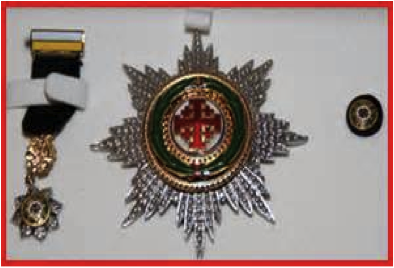


Because the star is heavy and may be difficult to pin on certain fabrics, it is also appropriate to wear it suspended from a black ribbon, in which case the cross is not worn.
Lady Grand Cross (LGCHS)
This is the highest rank for Dames, who receive a large Jerusalem Cross and golden bow suspended from a wide black sash. A large eight-pointed star, charged with the Jerusalem Cross, is also worn.
The sash is worn diagonally over the right shoulder with the Jerusalem Cross on the left hip. The sash is worn only with white-tie formal attire.
The star is pinned on the left side of the dress or suspended from a black ribbon. It is never pinned to the outside of the cloak.

Knight or Lady of the Collar
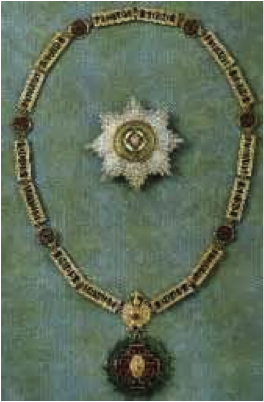
The Collar is conferred on the most eminent persons, ecclesiastic or lay, of the highest dignity, in most exceptional cases. This rank is rarely conferred. It is due by right to the Cardinal Grand Master and the Latin Patriarch and is granted to certain members of the Grand Magisterium.
The Pilgrim Shell

As stated earlier, the Pilgrim Shell is awarded to Knights and Dames who complete a pilgrimage to the Holy Land that includes visiting works of the Order, education on the situation among the Catholic population in the Holy Land and praying at the Church of the Holy Sepulchre.
Normally it is presented by the Latin Patriarch of Jerusalem, or his representative, and consists of a scalloped shell in silver in the center of which is placed the Jerusalem Cross in red, bordered in gold.
The shell reminds us that we are all pilgrims on earth, members of a pilgrim Church. It is also a pledge to aid the needy, especially in the Holy Land.
While not officially presented with the Pilgrim Shell, a miniature Pilgrim Shell may be purchased. Knights and Dames who have made a pilgrimage to the Holy Land are encouraged to wear the miniature Pilgrim Shell with, or instead of, the rosette.
The Pilgrim Shell is pinned to the center of the Jerusalem Cross on the cape of both Knights and Dames. The flat side of the shell is worn up. Except for the special Jubilee 2000 medal, this is the only decoration worn on or outside the mantle.
The Pilgrim Shell, or its miniature, should be worn on anything except casual attire during the Lieutenancy’s annual meeting. The miniature Pilgrim Shell may be worn at any time with business attire.
The Pilgrim Shell should be worn with formal attire, white tie, dinner jacket, black tie, or business attire at Order-related functions. Both Knights and Dames should wear the Pilgrim Shell, or its miniature, on the left shoulder of any attire other than casual attire, and above any other insignia or decorations, except the Jubilee 2000 medal.
The Pilgrim Shell can be worn with any other of the Order’s insignia.
Clergy Insignia and Decorations
Clergy Knights of the Order wear a mozzetta with biretta.
When wearing choir dress, the mozzetta is worn over the cassock of the color appropriate to the cleric’s ecclesiastical rank, with a rochet and biretum.

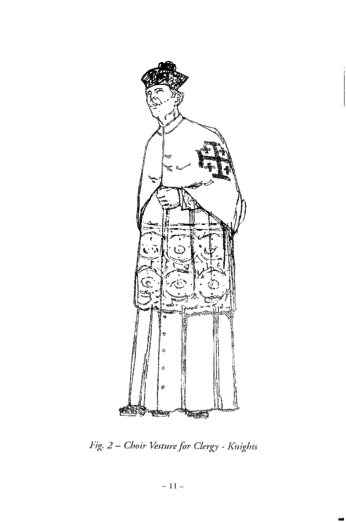
Priest-knights wear their insignia of rank, pendent from the neck. The insignia are identical to those of the lay Knights.
For the celebration of Mass, concelebrants wear the Mass vestments with no insignia. Non-concelebrants are to wear choir vesture as detailed above.
For non-liturgical occasions, the clergy wear cassock, sash, ferraiolone and insignia.
Palms of Jerusalem
The Palm of the Order bears on its face the Cross of Godfrey de Bouillon on a shield of gold, silver or bronze, surmounted by the motto Deus lo vult. The entirety is surrounded by two Palms in elliptic form, one with olive branches, the other with branches of laurel, enameled in green.
On the reverse side is engraved the inscription Palma Equestris Ordinis Sancti Sepulcri Hierosolymitani.
Those decorated with the Palm of the Order wear the Palm on their left chest, hung on a ribbon of watered black silk.

Other Decorations
Knights and Dames who have been awarded other decorations for military or governmental service, who have received other Papal honors, or who belong to other Catholic orders, for example, the Order of Malta, may wear these decorations at the same time as those of the Equestrian Order.
Awards of Merit
The Constitution of the Order provides in unusual circumstances for the awarding of honors to persons of unquestionable moral conduct in recognition of particular meritorious charity in the Holy Land. Such persons do not assume responsibilities imposed on Knights and Dames. The recipients do not receive the title Knight or Lady of the Order.
Insignia and Apparel Guide
Insignia of Merit are of three classes: Cross of Merit, Cross of Merit with Silver Star, and Cross of Merit with Gold Star. Merit emblems are worn similar to those insignia bestowed upon Knights and Dames of the Order of the Holy Sepulchre of Jerusalem. No capes are worn and award of the Cross of Merit does not confer membership in the Order.
Knights

Other Orders of Knighthood
Note of Clarification from the Secretariat of State
Vatican City, 16 October 2012 (VIS), In response to frequent requests for information concerning the recognition by the Holy See of Equestrian Orders dedicated to the saints or to holy places, the Secretariat of State considers it opportune to reiterate what has already been published, namely that, other than its own Equestrian Orders, the Holy See recognizes and supports only the Sovereign Military Order of Malta, also known as the Sovereign Military Hospitaller Order of Saint John of Jerusalem of Rhodes and of Malta, and the Equestrian Order of the Holy Sepulchre of Jerusalem. The Holy See foresees no additions or innovations in this regard.
All other orders, whether of recent origin or mediaeval foundation, are not recognized by the Holy See. Furthermore, the Holy See does not guarantee their historical or juridical legitimacy, their ends or organizational structures.
To avoid any possible doubts, even owing to illicit issuing of documents or the inappropriate use of sacred places, and to prevent the continuation of abuses which may result in harm to people of good faith, the Holy See confirms that it attributes absolutely no value whatsoever to certificates of membership or insignia issued by these groups, and it considers inappropriate the use of churches or chapels for their so-called “ceremonies of investiture.”